TOTAL QUALITY MANAGEMENT (TQM), JALAN ALTERNATIF MEMPERBAIKI MANAJEMEN PERGURUAN TINGGI
- Authors
-
-
Khamdan Rifa'i
-
- Abstract
In this life, changes will never end, and so changes in the implementation of management along with the more complex organizational problems. That's why adoption, creation, and innovation are needed. Total quality management is now widely employed in managing organization and management, including tertiary educational institution that also has three elements (namely; input, process and output) and also places human resources as vital component. Human resources, as a vital component in tertiary level, should get attention and treatment as mentioned in TQM, for example in shared vision, cross-functional cooperation, empowerment and involvement, participative management style, available advanced training and effective communication channel. Thus, the application of TQM is actually one of the efforts to change irrational-traditional management into rational-modern management, one of whose elements is decision making based on fact.
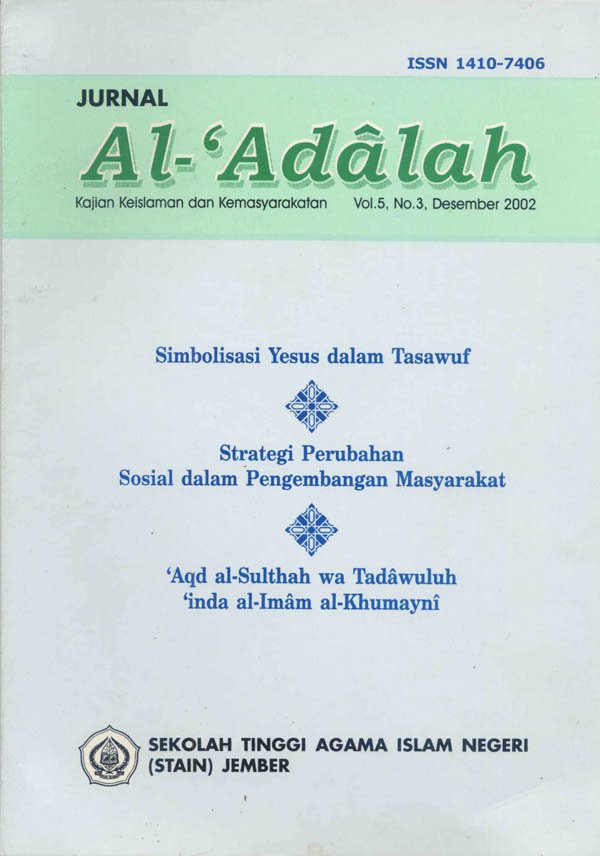
- Cover Image
-
- Downloads
- Published
- 2022-04-05
- Issue
- Vol. 5 No. 3 (2002)
- Section
- Articles
- License
-

This work is licensed under a Creative Commons Attribution-NonCommercial 4.0 International License.
Authors retain copyright in their published works and grant Al’Adalah: Journal of Islamic Studies the right of first publication.
Articles published under the journal's current licensing policy are distributed under the Creative Commons Attribution-NonCommercial 4.0 International License (CC BY-NC 4.0). This license permits readers to share and adapt the licensed material for noncommercial purposes, provided that appropriate credit is given, the original publication is acknowledged, a link to the license is provided, and any changes are indicated.
The license does not authorize commercial reuse without additional permission from the relevant rights holder, except where applicable copyright exceptions or limitations permit such use. Third-party materials may be subject to separate copyright restrictions.
Full license terms: https://creativecommons.org/licenses/by-nc/4.0/
Licensing arrangements for previously published articles remain subject to the terms applicable to those articles.
