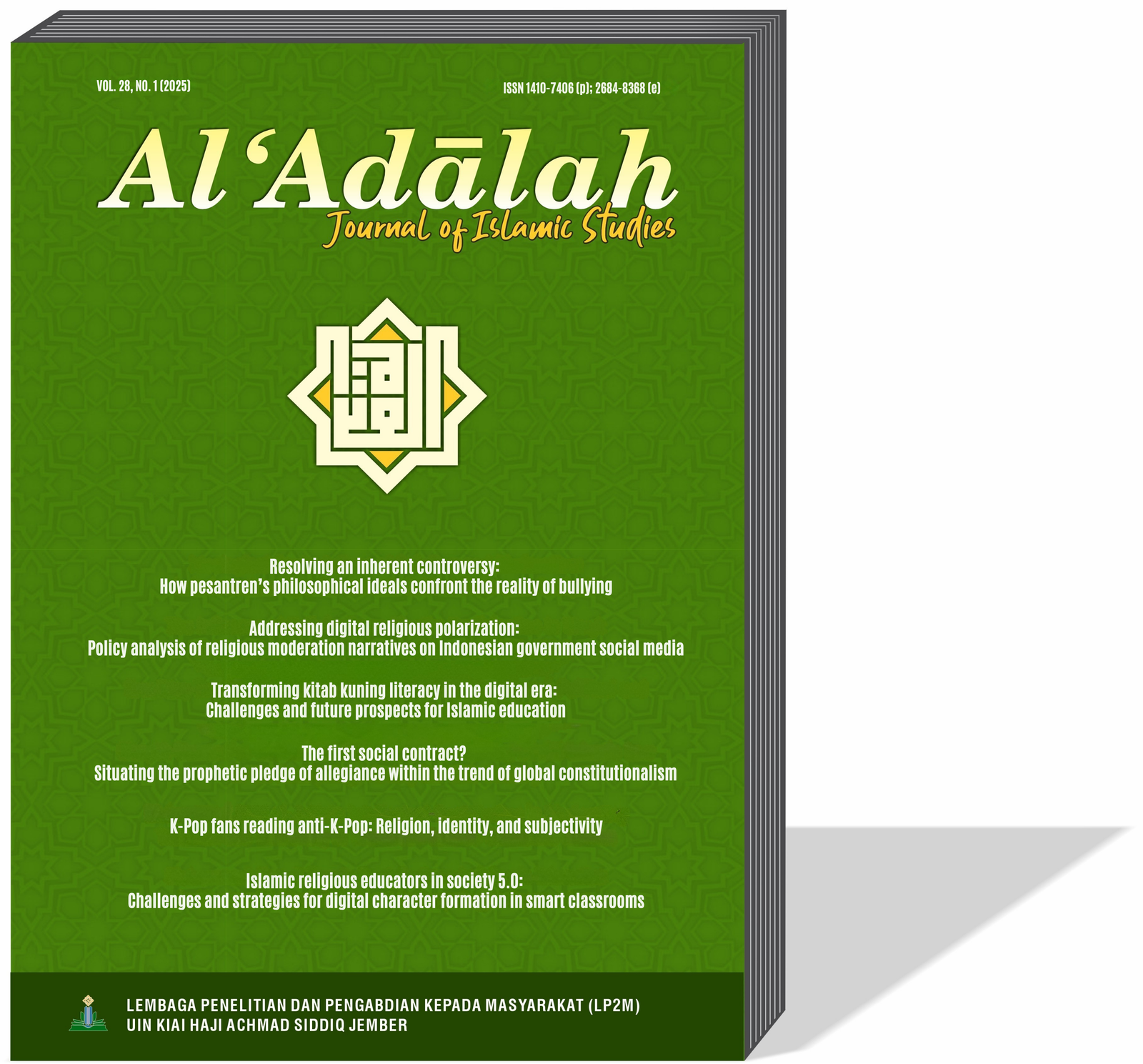
The first social contract? Situating the prophetic pledge of allegiance within the trend of global constitutionalism
DOI:
https://doi.org/10.35719/aladalah.v28i1.568Over the past decade, global constitutionalism has progressively sought to constrain the power of digital platforms. Nevertheless, existing frameworks largely rely on Western social contract traditions, often overlooking the structural inequities present in digitally mediated governance. This article argues that the prophetic pledge of allegiance (bai’ah) is fundamental covenantal form of the social contract, offering an alternative paradigm of political legitimacy distinct from liberal individualism. It utilises a qualitative, library-based methodology that integrates socio-historical reconstruction of early Islamic primary sources with normative-conceptual and comparative constitutional analysis. The article demonstrates that bai’ah produces four fundamental constitutional principles: mutual consent, normative constraints on authority, safeguarding of the public interest, and collective accountability. These findings indicate that legitimacy in the prophetic model is based not on superficial procedural adherence but on a morally binding and mutually accountable political relationship. This study reconstructs bai’ah as a foundation for constitutional ethics, thereby enriching current discussions on global and digital constitutionalism by providing a more diverse normative framework for reconsidering consent, accountability, and justice in platform governance. The covenantal logic of bai’ah offers a valuable framework for assessing and normatively limiting private digital power, especially when current governance structures inadequately safeguard vulnerable communities.
Downloads
References
Ahmad, J. (2025). Reactualizing Classical Islamic Power: Reinterpreting Al-Mawardi in Post-Reform Indonesian Democracy. Jurnal Ushuluddin, 33(1), 188. https://doi.org/10.24014/jush.v33i1.36559
Al-Bukhari, M. ibn I. (2009). Al-Jami’ Al-Musnad Al-Sahih (M. Al-Almany, Ed.; M. M. Khan, Trans.; 1st ed.). Islamhouse.
Anello, G. (2021). The Concept of “Contractual Citizenship” in the Charter of Medina (622 C.e.): A Contemporary Interpretation (SSRN Scholarly Paper No. 3784632). Social Science Research Network. https://doi.org/10.2139/ssrn.3784632
Belhaj, A. (2025). From Divine to Popular Sovereignty: The Civil Shift in Contemporary Islamic Political Thought. Religions, 16, 622. https://doi.org/10.3390/rel16050622
Bell, D. S. A. (2003). Political theory and the functions of intellectual history: A response to Emmanuel Navon. Review of International Studies, 29(1), 151–160. https://doi.org/10.1017/S026021050300010X
Burkhardt, G., Boy, F., Doneddu, D., & Hajli, N. (2023). Privacy Behaviour: A Model for Online Informed Consent. Journal of Business Ethics, 186(1), 237–255. https://doi.org/10.1007/s10551-022-05202-1
Celeste, E. (2019). Digital constitutionalism: A new systematic theorisation. International Review of Law, Computers & Technology, 33(1), 76–99. https://doi.org/10.1080/13600869.2019.1562604
Choat, S. (2021). Decolonising the political theory curriculum. Politics, 41(3), 404–420. https://doi.org/10.1177/0263395720957543
Clemons, E. K., Waran, R. V., Hermes, S., Schreieck, M., & Krcmar, H. (2022). Computing and Social Welfare. Electronic Markets, 32(2), 417–436. https://doi.org/10.1007/s12525-021-00512-0
Da Conceição, L. H. M. (2024). A constitutional reflector? Assessing societal and digital constitutionalism in Meta’s Oversight Board. Global Constitutionalism, 13(3), 557–590. https://doi.org/10.1017/S2045381723000394
De Gregorio, G. (2022). Digital constitutionalism across the Atlantic. Global Constitutionalism, 11(2), 297–324. https://doi.org/10.1017/S2045381722000016
De Gregorio, G., & Radu, R. (2022). Digital constitutionalism in the new era of internet governance. International Journal of Law and Information Technology, 30(1). https://doi.org/10.1093/ijlit/eaac004
Djatmiko, G. H., Sinaga, O., & Pawirosumarto, S. (2025). Digital Transformation and Social Inclusion in Public Services: A Qualitative Analysis of E-Government Adoption for Marginalized Communities in Sustainable Governance. Sustainability, 17(7), 2908. https://doi.org/10.3390/su17072908
Golia, A. J. (2024). Critique of digital constitutionalism: Deconstruction and reconstruction from a societal perspective. Global Constitutionalism, 13(3), 488–518. https://doi.org/10.1017/S2045381723000126
Hasan, B. M. M., Imad, D., & Gammal, M. M. E. (2025). Nation and Citizenship in the Medina Charter: An Analysis of Constitutional Foundations and Standards and Their Role in Promoting Civilizational Coexistence. Malaysian Journal of Syariah and Law, 13(2), 476–501. https://doi.org/10.33102/mjsl.vol13no2.1259
Hillani, A. M. (2023). Hobbes Among the Savages: Politics, War, and Enmity in the So-called State of Nature. Hobbes Study. https://doi.org/10.1163/18750257-bja10057
Hoeksema, B. (2024). Digital Sovereignty, the Private Sector, and a Social Republican Alternative. Digital Society, 3(3), 51. https://doi.org/10.1007/s44206-024-00140-z
Holcombe, R. G. (2021). Contractarian ideology and the legitimacy of government. Journal of Institutional Economics, 17(3), 379–391. https://doi.org/10.1017/S1744137420000521
Ibn Hisham, A. M. (1990). Al-Sirah Al-Nabawiyah (3rd ed., Vol. 2). Dar al-Kitab al-‘Arabi.
Kausche, K., & Weiss, M. (2025). Platform power and regulatory capture in digital governance. Business and Politics, 27(2), 284–308. https://doi.org/10.1017/bap.2024.33
Kużelewska, E., Malinowski, D., & Tomaszuk, M. (2025). Human Rights and Digital Choice: Rethinking the Right (Not) to Use the Internet. Białostockie Studia Prawnicze, 30(4), 57–72. https://doi.org/10.15290/bsp.2025.30.04.04
Lang Jr, A. F. (2021). Global constitutionalism: A practical universal. Global Constitutionalism, 10(2), 367–375. https://doi.org/10.1017/S2045381721000149
Little, A. (2018). Contextualizing Concepts: The Methodology of Comparative Political Theory. The Review of Politics, 80(1), 87–113. https://doi.org/10.1017/S003467051700078X
López-de-Arana Prado, E. (2025). Reconceptualising the Digital Gender Divide, Accommodating New Forms of Virtual Gender-Based Violence. Behavioral Sciences, 15(11), 1568. https://doi.org/10.3390/bs15111568
Lubis, R., Lubis, R. H., Sulaiman, H., Purnama, D., Nuranisah, N., & Isyanto, N. (2025). Reconstruction of the Principle of People’s Sovereignty Based on the Perspective of Fiqh Siyasah. KARSA Journal of Social and Islamic Culture, 33(2), 770–802. https://doi.org/10.19105/karsa.v33i2.20852
Mangold, S. (2023). Data privacy and digital work platforms in global perspective. Italian Labour Law E-Journal, 16(1), 109–125. https://doi.org/10.6092/issn.1561-8048/16472
March, A. F. (2009). What Is Comparative Political Theory? The Review of Politics, 71(4), 531–565. https://doi.org/10.1017/S0034670509990672
Namazi, R. (2023). Islamic Political Thought and the “Constitution of Medina.” Comparative Political Theory, 3(2). https://doi.org/10.1163/26669773-bja10052
Rahman, H. (2020). An Evaluation of the Aqabah Pledges and the Charter of Medina to the Birth of Political Authority in Islamic Political Thought. İnsan ve Toplum Bilimleri Araştırmaları Dergisi, 9(5), 3379–3396. https://doi.org/10.15869/itobiad.748609
Rane, H. (2022). Interfaith Actor Reception of Islamic Covenants: How ‘New’ Religious Knowledge Influences Views on Interreligious Relations in Islam. Religions, 13(9), 873. https://doi.org/10.3390/rel13090873
Schmager, S., Grøder, C. H., Parmiggiani, E., Pappas, I., & Vassilakopoulou, P. (2024). Exploring citizens’ stances on AI in public services: A social contract perspective. Data & Policy, 6, e19. https://doi.org/10.1017/dap.2024.13
Seabright, P., Stieglitz, J., & Van der Straeten, K. (2021). Evaluating social contract theory in the light of evolutionary social science. Evolutionary Human Sciences, 3, e20. https://doi.org/10.1017/ehs.2021.4
Sethi, A. (2024). Looking beyond the constituent power theory: The theory of equitable elite bargaining. Global Constitutionalism, 13(1), 126–153. https://doi.org/10.1017/S2045381723000096
Terzis, P. (2024). Against digital constitutionalism. European Law Open, 3(2), 336–352. https://doi.org/10.1017/elo.2024.15
Tomasello, F. (2023). Digital Civics and Algorithmic Citizenship in a Global Scenario. Philosophy & Technology, 36(2), 39. https://doi.org/10.1007/s13347-023-00638-3
Velez, E. D. (2024). The Colonial Contract and the Coloniality of Gender: Decolonial Feminist Reflections on Charles Mills’s Racia-Sexual Contract. Critical Philosophy of Race, 12(2). https://doi.org/10.5325/critphilrace.12.2.0366
Viellechner, L. (2019). The transnational dimension of constitutional rights: Framing and taming ‘private’ governance beyond the state. Global Constitutionalism, 8(3), 639–661. https://doi.org/10.1017/S2045381719000194
Zaman, J. Q. (2024). The Legal Politics of Formality and Substance of the Medina Constitution. TSAQAFAH, 20, 293–322. https://doi.org/10.21111/tsaqafah.v20i2.11319
Downloads
Section
License
Copyright (c) 2025 Nasir Hassan Wani, Areesha Azhar

This work is licensed under a Creative Commons Attribution-NonCommercial 4.0 International License.





















 Al'Adalah licensed under Creative Commons Attribution-NonCommercial 4.0 International License.